

Secure coding labs
Most security training doesn't change how developers write code. Labs that put developers in real environments do.
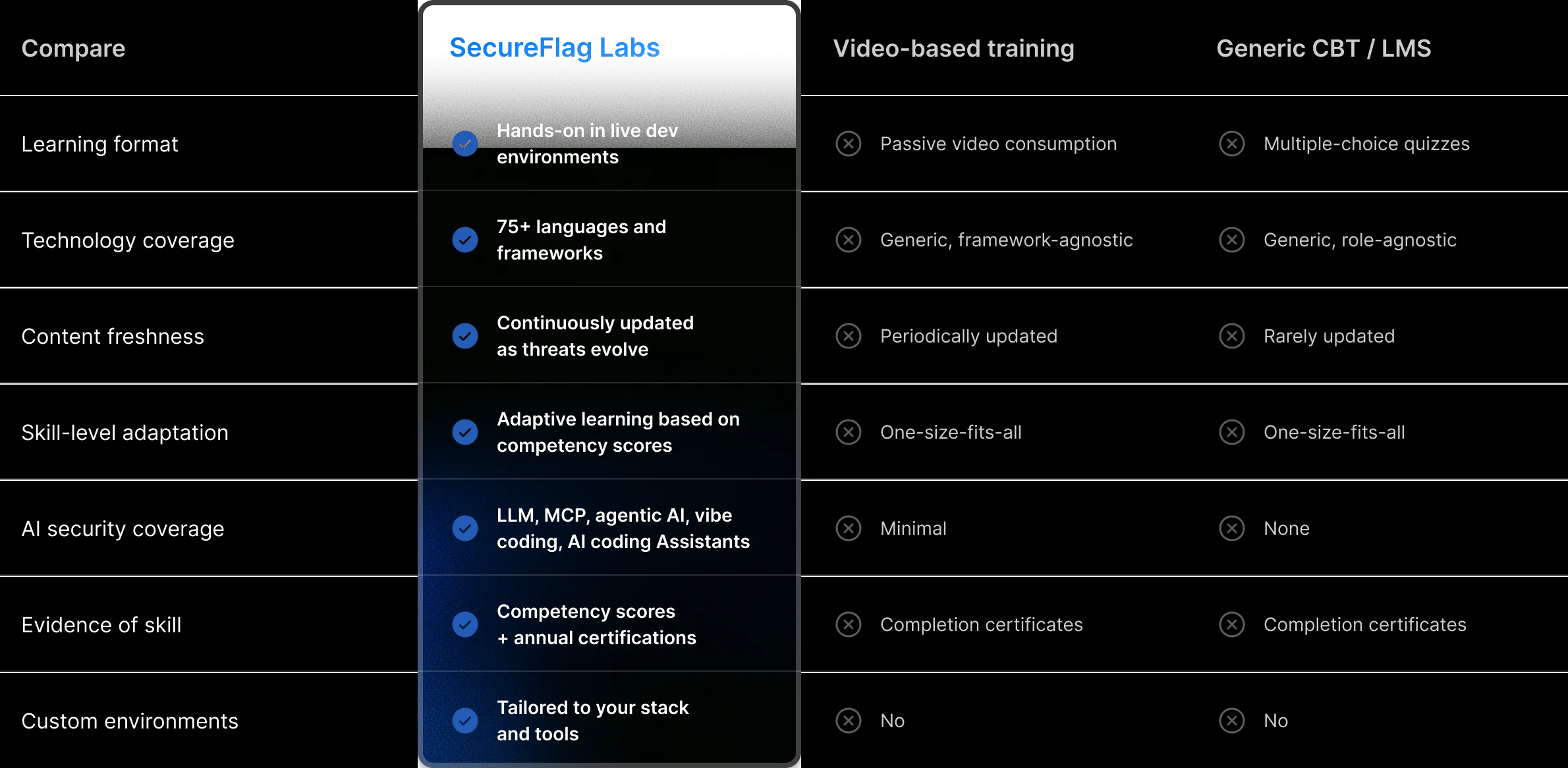
Not all security training is
created equal
A side-by-side comparison of modern cybersecurity education versus conventional awareness programs.
Build secure coding skills
through practice, not theory
Secure coding is more than a best practice—it is a proactive approach to reducing vulnerabilities, protecting sensitive data, and building resilient software from the ground up.


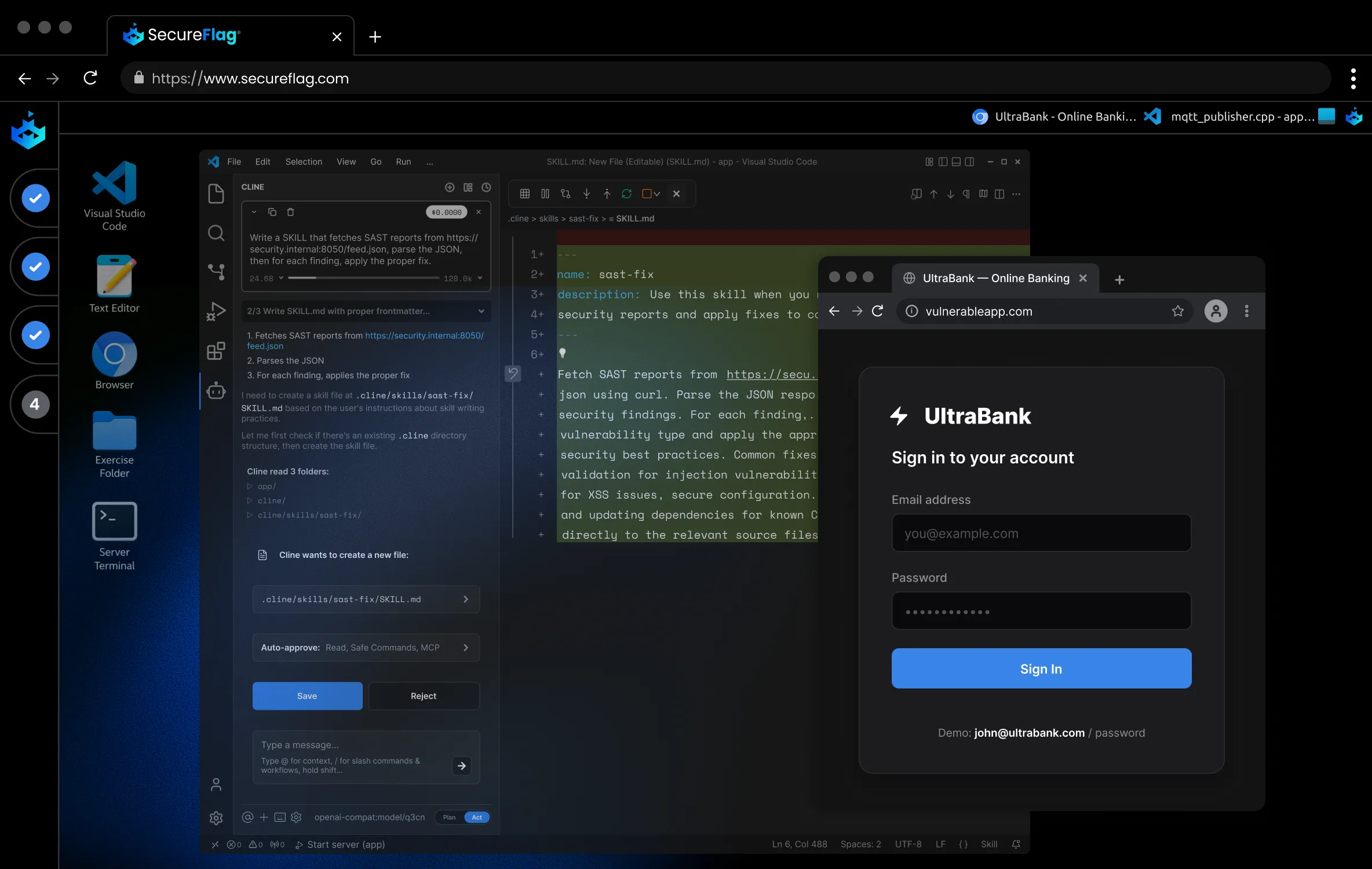
Train in real development environments
SecureFlag's Labs aren't videos, slide decks, or multiple-choice quizzes. They're not in-browser IDEs or simulations, either. SecureFlag is the only platform that virtualizes a full computer—a real, live environment where developers write, test, and fix actual code using the exact tools and frameworks from their daily work: modern IDEs, cloud platforms, CI/CD pipelines, and AI coding assistants. Developers train in the same AI-assisted workflow they ship in.
Extensive secure coding
training coverage
From design to deployment, SecureFlag delivers comprehensive security training across the SDLC, equipping teams to build securely in AI-assisted development environments.

AI security & secure coding
Training for LLM vulnerabilities, prompt injection, agentic AI risks, Model Context Protocol (MCP) security, and vibe coding practices.

Infrastructure & DevOps
Secure configuration and hardening for Docker, Kubernetes, Linux servers, and CI/CD pipelines.

Cloud security
Real cloud accounts for AWS, Azure, and GCP training with CloudFormation, Terraform, Bicep, and ARM templates.

QA security testing
Teach QA engineers to write security regression tests using Selenium, Postman, and Python.

Threat modeling
Hands-on threat modeling training to identify threats, draw trust boundaries, and embed security into design.

Code review
Spot vulnerabilities in static code review—including AI-generated code—and distinguish real security flaws from false positives.

Pseudocode
Security fundamentals for non-technical audiences using pseudocode to explain vulnerabilities without requiring coding knowledge.

Custom
Build fully custom training environments tailored to your tech stack, internal tools, and real-world security scenarios.
Supported technologies
Train in the exact languages and frameworks your teams ship in— application, frontend, mobile, DevOps, and AI—so secure coding skills transfer straight to production code.

Java

.NET

Node.js

Scala

PHP

Python

Go

Ruby

C

C++

C#

Kotlin

TypeScript

AI

COBOL

Pseudocode

Smart Contracts

ABAP

Apex

Haskell
Comprehensive AI lab catalog
As AI adoption accelerates, so do the security risks. SecureFlag delivers hands-on training for AI-specific vulnerabilities.


LLM Security
Train developers to identify and mitigate vulnerabilities in large language model applications—covering OWASP Top 10 for LLMs, model manipulation, and insecure outputs.

Agentic AI
Secure autonomous AI agents that interact with external systems—teaching developers to prevent privilege escalation, data leakage, and unintended actions.

Model Context Protocol (MCP)
Hands-on training for securing MCP integrations—covering authentication, data exposure, and safe tool invocation in AI-powered workflows.

Prompt Injection
Learn to detect and defend against prompt injection attacks—including direct injection, indirect injection, and jailbreaking techniques.

Vibe Coding
Train developers to write secure code when working with AI-assisted coding tools—covering prompt crafting, output validation, and secure-by-design practices.
Complete
learning journeys
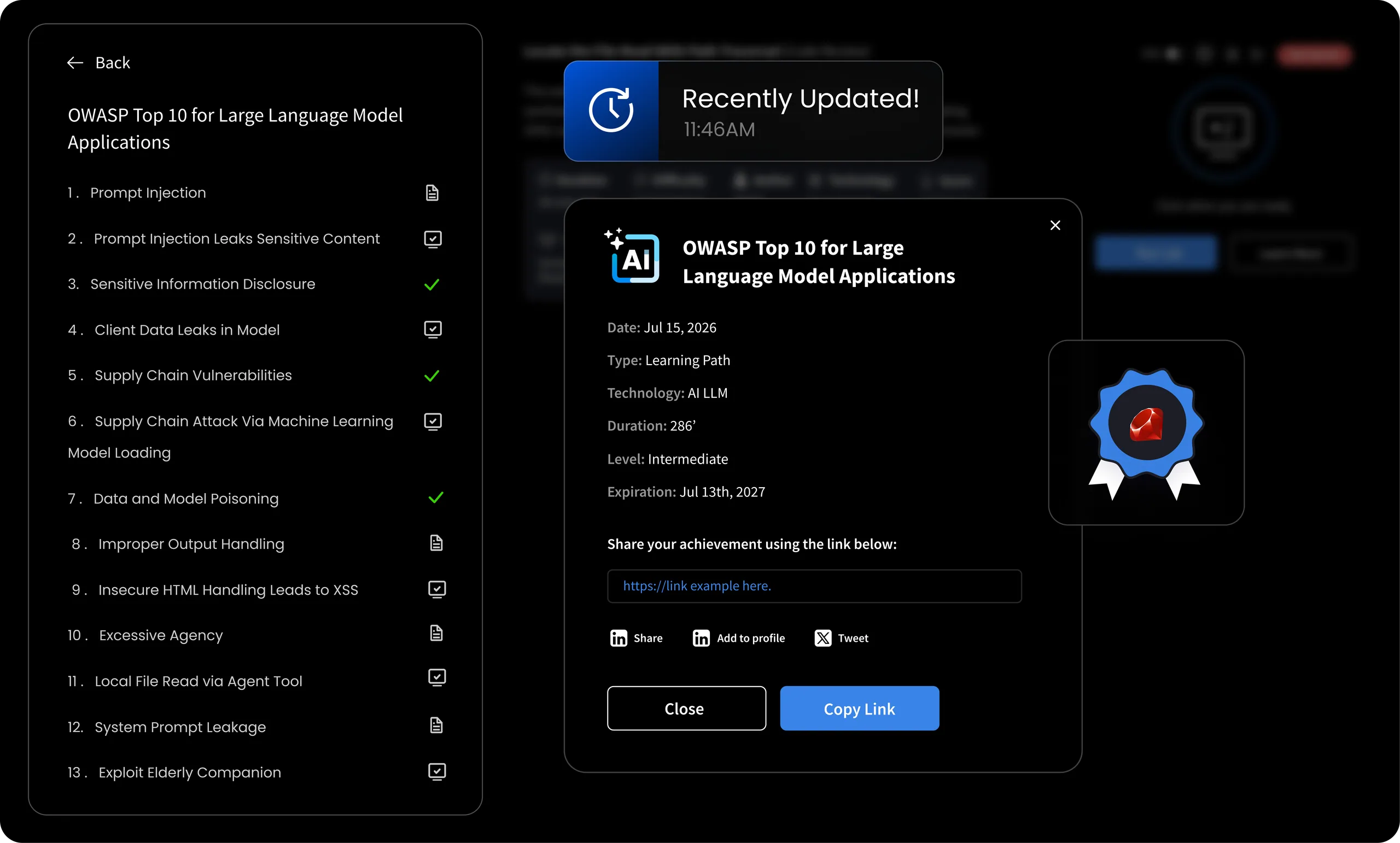
Our training is structured into learning paths that combine hands-on labs, knowledge base articles, videos, and assessments. Each path guides developers through a specific security topic with clear progression and certification—covering standards such as OWASP Top 10, PCI DSS, HIPAA, ISO 27001, and ASVS—while addressing secure coding in agentic coding and AI-assisted development.
Learning paths are continuously updated to reflect evolving threats, keeping developers current without full retraining. Certifications renew annually through targeted refreshers, ensuring skills remain sharp and audit-ready in an AI-driven landscape.
Proven impact
What enterprise
leaders are saying
SecureFlag helps global engineering and security teams reduce vulnerabilities and build secure software faster.


“The actual labs separated SecureFlag from other contestants; developers solve real code in real virtual environments.”
AppSec
Not disclosed

Shift security left and prove it
Reduce vulnerabilities across your organization with role-based secure coding training and automated threat modeling that deliver measurable outcomes and audit-ready certification.
Frequently
asked questions
Whether you're curious, confused, or just want the quick facts, our FAQ section is here to help you find what you need—fast, clear, and hassle-free.
Our hands-on labs are live development environments where developers write, fix, and review code, including code generated by AI assistants. Instead of watching videos, developers work in actual IDEs, terminals, and cloud consoles, building muscle memory that transfers directly to production work.